28 de April de 2026
Custom flight cases vs standard flight cases: differences and benefits
Find out why choosing between a standard and a customised format can make or break your logistics and transport operations
Impacts, vibrations, temperature changes and the constant hustle and bustle of loading and unloading from lorries or aeroplanes put any equipment to the test. To combat this, flight cases offer the protection you need.
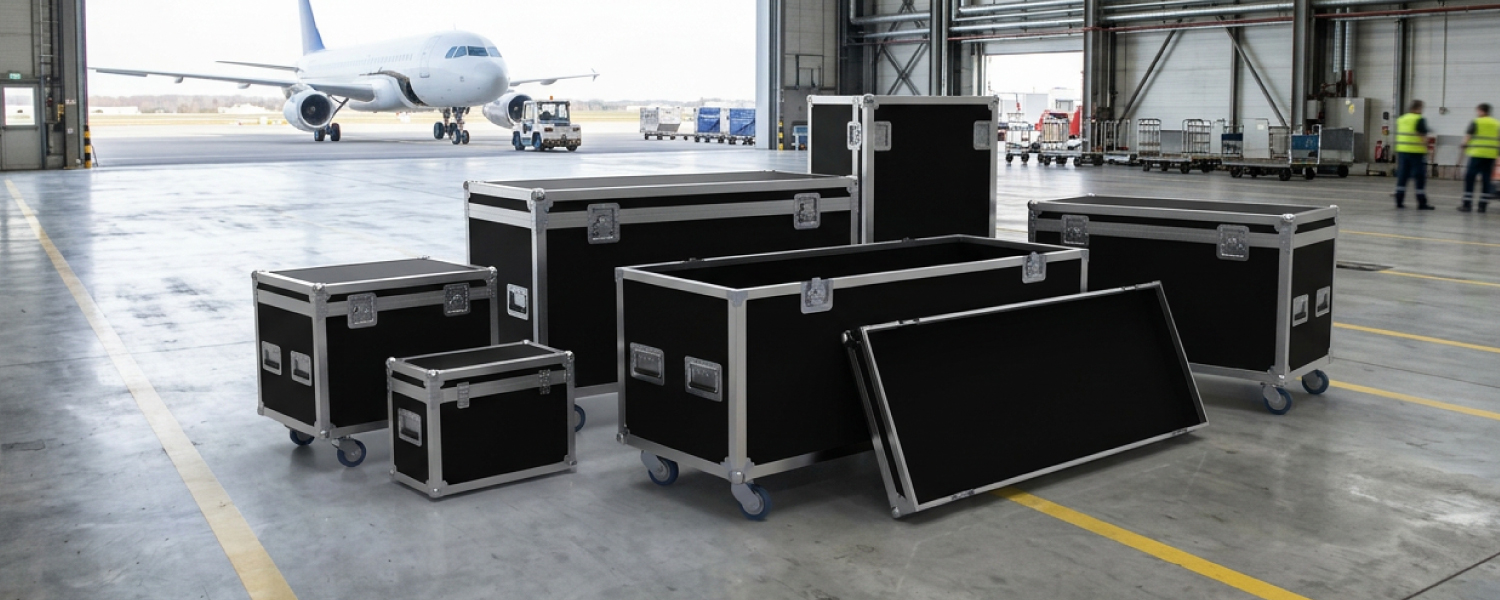
In the demanding worlds of show business, the audiovisual industry, medicine or engineering, moving high-value equipment from one place to another involves inevitable risks. Impacts, vibrations, temperature changes and the constant hustle and bustle of loading and unloading from lorries or aeroplanes put any equipment to the test. To combat this, flight cases offer the protection you need.
However, when it comes to purchasing this transport packaging, a very common question arises: is a generic option sufficient, or is it worth investing in a bespoke flight case?
Let’s take a detailed look at the comparison between the two options, highlighting their differences and advantages to decide which is the perfect solution to ensure your equipment always arrives at its destination intact.
What is a standard flight case?
A standard flight case is a mass-produced transport case with predefined dimensions. They are designed to accommodate widely used equipment or standardised formats within the industry.
For example, 19-inch racks for sound equipment, generic cable cases, or cases for very specific spotlight models are typically mass-produced.
Advantages of the standard format:
- Immediate availability: As they are mass-produced, they are usually in stock and ready for quick dispatch.
- Lower cost: Industrialised production reduces design and manufacturing costs, resulting in a lower final price.
- Basic versatility: Standard open-sided cases can be used to transport almost anything that does not require precise protection (such as cabling, curtains or metal structures).
The benefits of a bespoke flight case
When we talk about a bespoke flight case, we are referring to an engineering and design solution created from scratch for a specific piece of equipment or set of equipment. It is not just about the outer case, but a comprehensive project that takes into account the shape, weight and fragility of the contents.
Why a bespoke flight case stands out:
- Precision fit: The interior is designed using CNC-machined technical foam that precisely matches the shape of your equipment. This eliminates any internal slack or vibration.
- Space optimisation: A bespoke design allows you to group various items (screens, accessories, cables, batteries) within a single container in a logical and orderly manner, saving space during transport.
- Ergonomic design: You can incorporate ramps, pull-out drawers, hinged lids that convert into work surfaces or integrated lifting systems, amongst other features.
- Corporate image: As it is a custom flight case, you can choose the colours of the panels, add screen-printed graphics or engrave your company logo, projecting an image of the utmost professionalism to your clients.
Key differences: Bespoke flight cases vs standard flight cases
To make the right choice, it is essential to understand the differences between these two options:
- Real impact protection: Whilst a standard model may require you to use additional padding (bubble wrap, generic foam) that does not always absorb shocks well, a bespoke design ensures that the density of the internal foam is calculated precisely for the weight and fragility of the contents.
- Lead time: The standard model is a quick purchase. The bespoke option requires a design process, plan validation and manufacturing, so delivery times are slightly longer.
- Long-term investment: A bespoke design involves a higher initial investment. However, in the long term, it pays for itself by avoiding repairs to delicate equipment and reducing set-up and dismantling times at events, for example.
- Logistics: Bespoke flight cases can be designed to fit the standard dimensions of transport lorries, optimising cargo space to the maximum and saving on logistics costs.
When should you choose which one? Recommendations
Your choice will depend on the type of equipment you’ll be transporting and your day-to-day operations:
- Opt for a standard flight case if: You need to store general, non-fragile items (cables, clamps, slings); you require racks for equipment that already complies with the 19" standard; you’re on a very tight budget; or you need the case urgently.
- Invest in a bespoke flight case if: You transport high-value equipment (film cameras, medical equipment, lasers), components with irregular shapes, systems that need to be connected and ready for use straight out of the box, or if you want to reinforce your company’s brand image at every event.
Casemedia: Your expert in bespoke protection
Choosing the right protection ensures the viability of your work. At Casemedia, we’re not just distributors; we’re manufacturers with years of experience in the sector. We use cutting-edge 3D design and cutting technology to create the perfect bespoke flight case for you.
We understand that every client and every piece of equipment is unique. That’s why we analyse your transport, ergonomic and logistical needs to offer you a bespoke flight case that not only protects your investment but also makes your day-to-day work easier.
If you’re unsure which solution is best for you, visit our online shop to explore our options or get in touch with our team of engineers. Tell us what you need to transport, and we’ll take care of protecting it.
Latest news

08/09/2026
Flight cases for the healthcare sector: safe transport of medical equipment
Flight cases for the healthcare sector offer a solution designed to protect this equipment during storage ...
Learn more
31/08/2026
CASEMEDIA will be exhibiting at Advanced Manufacturing Madrid 2026
Once again this year, we will be at IFEMA Madrid to showcase our technical packaging and protection solutions, ...
Learn more
15/07/2026
Flight cases for the aviation sector
No two projects are the same within the aeronautical sector. Each piece of equipment has different dimensions, ...
Learn more